PLC vs HMI: Roles, Differences & How They Work Together in Factory Automation
Factory automation has transformed modern industries by improving productivity, reducing manual work, and increasing operational efficiency. At the heart of every automated system are two essential technologies: PLC (Programmable Logic Controller) and HMI (Human Machine Interface). While these systems work closely together, they serve completely different purposes. Understanding the difference between a PLC and HMI helps manufacturers choose the right automation solution and optimize industrial processes.
Whether you're automating a production line, water treatment plant, packaging unit, or manufacturing facility, both PLCs and HMIs play a vital role in ensuring smooth operations. However, selecting the right combination depends on your application, machine complexity, and production requirements.
At NEXGEN ELECTROMECH PRIVATE LIMITED, we provide advanced PLC, HMI, VFD, and industrial automation solutions for businesses across India. Our experts help industries design efficient automation systems that improve performance, reliability, and energy efficiency.
Website: https://www.nexgenelectromech.in/
Phone: 09874833686
In this guide, we'll explain the roles of PLCs and HMIs, their key differences, benefits, applications, and how they work together to create a smart factory automation system.
What is a PLC?
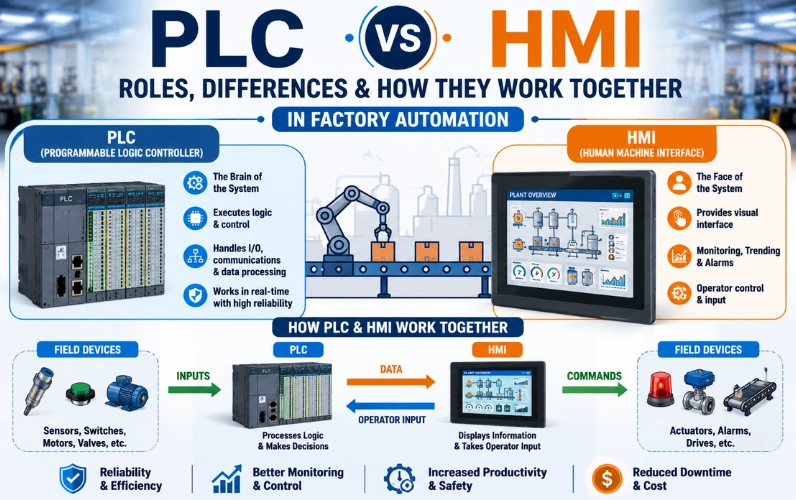
A Programmable Logic Controller (PLC) is an industrial computer designed to control machines and automated processes. It receives signals from sensors and input devices, processes the information according to a programmed logic, and sends commands to output devices such as motors, valves, relays, and actuators.
Unlike standard computers, PLCs are built to operate reliably in harsh industrial environments with dust, vibration, heat, and electrical noise.
Main Functions of a PLC
- Controls industrial machines
- Executes programmed logic
- Processes input and output signals
- Automates repetitive tasks
- Monitors sensors and switches
- Controls motors, pumps, and conveyors
- Communicates with other automation devices
PLCs are often called the "brain" of an automation system because they make real-time control decisions.
What is an HMI?
An HMI (Human Machine Interface) is a touchscreen or display panel that allows operators to interact with industrial machines. It provides a graphical interface where users can monitor equipment, view production data, adjust settings, and respond to alarms without accessing the PLC program.
Think of the HMI as the "face" of the automation system. It simplifies machine operation by presenting complex information in an easy-to-understand format.
Main Functions of an HMI
- Displays machine status
- Shows production data
- Monitors alarms and faults
- Allows operators to start and stop machines
- Adjusts operating parameters
- Displays trends and reports
- Improves operator safety and efficiency
PLC vs HMI: Key DifferencesFeature
PLC
HMI
Purpose
Controls machine operations
Displays information and allows operator interaction
Function
Executes automation logic
Provides visual monitoring and control
Programming
Ladder Logic, Structured Text, Function Block
Graphic screen design and interface configuration
Inputs
Sensors, switches, encoders
Touchscreen input from operators
Outputs
Motors, relays, valves, actuators
Visual displays, alarms, graphs, buttons
Operation
Runs automatically
Used by operators
Data Processing
High-speed logic execution
Data visualization and monitoring
Role
Brain of the system
User interface of the system
Although their roles are different, PLCs and HMIs are designed to work together seamlessly.
How Do PLC and HMI Work Together?
A PLC and HMI communicate continuously through industrial communication protocols such as Modbus, Ethernet/IP, PROFINET, or EtherNet/IP.
Here's how they work together:
- Sensors collect real-time machine data.
- The PLC receives the input signals.
- The PLC processes the programmed logic.
- The PLC controls motors, valves, pumps, or conveyors.
- The HMI displays machine status and operating data.
- Operators use the HMI to change settings or start and stop equipment.
- The PLC receives these commands and updates machine operations instantly.
This combination creates a smart, user-friendly automation system that improves efficiency and reduces errors.
Benefits of Using PLC and HMI Together
Combining PLCs and HMIs offers several advantages for industrial automation.
Improved Productivity
Automation reduces manual intervention and keeps production running efficiently.
Real-Time Monitoring
Operators can monitor machine performance, production counts, temperatures, pressures, and motor status in real time.
Faster Troubleshooting
HMIs display alarms and fault messages instantly, helping maintenance teams identify issues quickly.
Better Process Control
PLCs execute precise control logic while HMIs allow easy adjustment of production parameters.
Reduced Downtime
Quick fault detection and simplified machine operation minimize production interruptions.
Increased Safety
Operators can monitor equipment safely without directly interacting with hazardous machinery.
Data Collection
HMIs provide production reports, historical trends, and performance analysis for better decision-making.
Industries That Use PLC and HMI Systems
PLC and HMI solutions are widely used across many industries.
Manufacturing Plants
- Assembly lines
- CNC machines
- Conveyor systems
- Packaging machines
Water Treatment Plants
- Pump control
- Water level monitoring
- Chemical dosing systems
- Filtration systems
Food & Beverage Industry
- Mixing systems
- Filling machines
- Packaging lines
- Refrigeration systems
Textile Industry
- Weaving machines
- Dyeing equipment
- Spinning machines
Pharmaceutical Industry
- Batch processing
- Clean room automation
- Filling and packaging
Chemical Industry
- Process control
- Mixing tanks
- Flow monitoring
- Temperature control
HVAC Systems
- Chillers
- Cooling towers
- Air handling units
- Ventilation systems
Common Applications of PLC and HMI
Modern factories use PLC and HMI systems in numerous applications, including:
- Conveyor automation
- Motor control
- Pump automation
- Packaging machines
- Industrial robots
- Boiler control
- Compressor systems
- Elevator control
- Crane automation
- Material handling systems
- Food processing equipment
- Water pumping stations
- Plastic molding machines
- Printing machines
Choosing the Right PLC
Selecting the right PLC depends on your automation requirements.
Number of Inputs and Outputs
Choose a PLC with sufficient digital and analog I/O for current and future expansion.
Processing Speed
Complex machines require faster processors for real-time control.
Communication Protocols
Ensure compatibility with SCADA, HMI, VFDs, sensors, and other automation devices.
Memory Capacity
Larger applications require more program and data memory.
Environmental Conditions
Industrial environments may require PLCs with higher protection against dust, heat, or vibration.
Expansion Capability
Select a modular PLC if your production system may grow in the future.
Choosing the Right HMI
When selecting an HMI, consider these factors.
Screen Size
Choose a display size based on machine complexity and operator requirements.
Display Quality
A high-resolution touchscreen improves visibility and user experience.
Communication Compatibility
The HMI should support your PLC's communication protocol.
Data Logging
Choose an HMI with built-in data logging and reporting features if production analysis is important.
Alarm Management
Effective alarm screens help operators respond quickly to machine faults.
Remote Access
Some advanced HMIs support remote monitoring through Ethernet or cloud connectivity.
PLC and HMI Communication Protocols
Reliable communication ensures smooth automation.
Common industrial communication protocols include:
- Modbus RTU
- Modbus TCP/IP
- PROFINET
- EtherNet/IP
- CANopen
- Profibus
- OPC UA
The right protocol depends on your automation architecture and equipment compatibility.
Why PLC and HMI Are Essential for Industry 4.0
Industry 4.0 focuses on smart manufacturing, connected machines, and real-time data. PLCs and HMIs form the foundation of these intelligent systems by enabling seamless communication, process automation, and data-driven decision-making.
With advanced PLC and HMI solutions, manufacturers can:
- Monitor production remotely
- Optimize machine performance
- Reduce energy consumption
- Improve product quality
- Minimize downtime
- Integrate with IoT and SCADA systems
These capabilities help businesses stay competitive in today's rapidly evolving industrial landscape.
Why Choose NEXGEN ELECTROMECH PRIVATE LIMITED?
Selecting the right automation partner is just as important as choosing the right PLC and HMI.
NEXGEN ELECTROMECH PRIVATE LIMITED provides reliable industrial automation solutions tailored to your operational needs.
Why Work With Us?
- Genuine PLC and HMI solutions
- Expert automation consultation
- Customized system integration
- Competitive pricing
- Fast product availability
- Technical support and after-sales service
- Experienced automation engineers
- Solutions for multiple industries
Whether you need a simple machine control system or a complete factory automation solution, our team delivers reliable products and expert guidance.
Company Name: NEXGEN ELECTROMECH PRIVATE LIMITED
Website: https://www.nexgenelectromech.in/
Phone: 09874833686
Conclusion
Both PLC and HMI are essential components of modern factory automation, but they perform different roles. The PLC controls machines and executes automation logic, while the HMI provides operators with an easy-to-use interface for monitoring, controlling, and managing industrial processes. Together, they create efficient, reliable, and intelligent automation systems that improve productivity, reduce downtime, and enhance operational safety.
If you're planning to upgrade your factory or implement a new automation system, choosing the right PLC and HMI combination is critical for long-term success. At NEXGEN ELECTROMECH PRIVATE LIMITED, we help businesses select, integrate, and maintain advanced automation solutions tailored to their production requirements.
For expert guidance on PLCs, HMIs, VFDs, and industrial automation systems, contact our team today.
NEXGEN ELECTROMECH PRIVATE LIMITED
🌐 Website: https://www.nexgenelectromech.in/
📞 Phone: 09874833686