
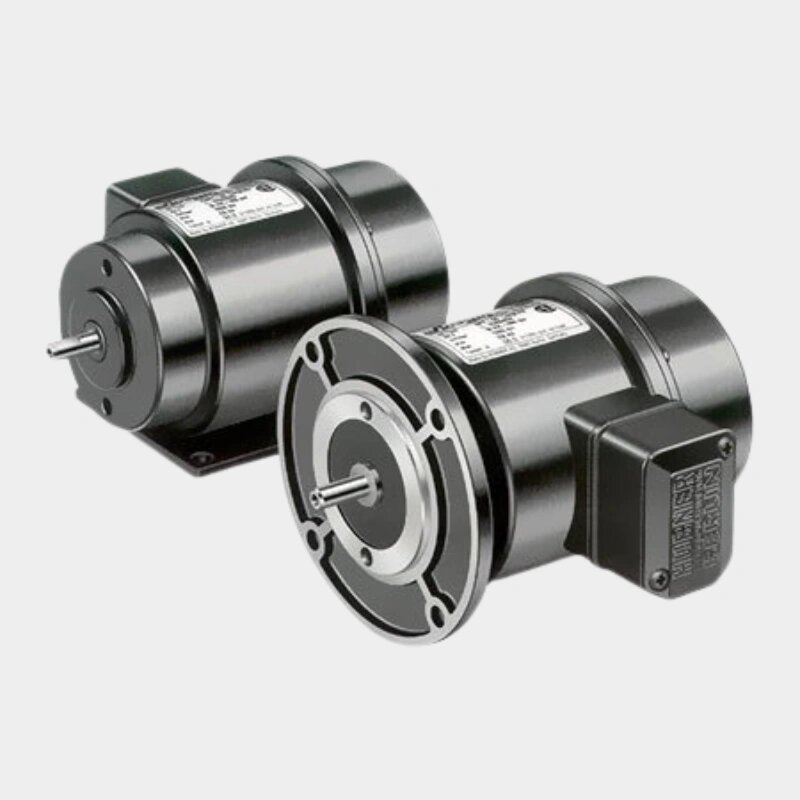
The TDP 0,2 is a DC tachogenerator from Baumer Hubner that produces an analog voltage output directly proportional to shaft speed, no external power supply required. unlike a digital encoder, which outputs discrete pulses for a controller to count, a tachogenerator generates its own signal purely from the rotating shaft, making it a self-contained, inherently simple speed feedback device. The TDP 0,2 outputs 10–150 mV per rpm, holds signal quality consistent across the entire rotational speed range thanks to Baumer's patented Longlife technique, and also indicates direction of rotation through the polarity of its output. With an aluminium die-cast housing, stainless steel shaft on its own bearings, and an operating temperature range extending to +130°C, it's built for continuous industrial duty on drives, motors, and rotating machinery where a straightforward, reliable analog speed signal is all that's needed.
The output signal's polarity indicates the sense of rotation, so a single tachogenerator provides both speed and direction feedback without needing a separate direction sensor.
| Spec | Details |
|---|---|
| Open-Circuit Voltage | 10–150 mV per rpm |
| Reversal Tolerance | 0.1% |
| Linearity Tolerance | 0.15% |
| Temperature Coefficient | 0.05%/K (open-circuit) |
| Isolation Class | B |
| Calibration Tolerance | 1% |
| Performance | 12 W (at speeds >3000 rpm) |
| Armature-Circuit Time Constant | <75 μs |
| Climatic Test | Humid heat, constant (IEC 60068-2-3, Ca) |
| Spec | Details |
|---|---|
| Flange Dimensions | 90 mm |
| Shaft | 7–14 mm, with flange, own bearings |
| Protection Rating | IP55 standard; IP56 optional (DIN EN 60529) |
| Torque | 1.5–0 Ncm |
| Rotor Moment of Inertia | 1.1 kgcm² |
| Shaft Loading | 60 N axial / 80 N radial |
| Housing Material | Aluminium die-cast |
| Shaft Material | Stainless steel |
| Operating Temperature | -30°C to +130°C |
| Vibration Resistance | 10 g, 10–2000 Hz (DIN EN 60068-2-6/27) |
| Shock Resistance | 300 g, 1 ms |
| Connection | Terminal box |
| Weight | Approx. 2.6 kg |
Find answers to common questions about our products and solutions.
A tachogenerator produces its own analog voltage output directly proportional to shaft speed, without needing an external power supply. A rotary encoder, by contrast, requires a power supply and produces digital pulse signals for a controller to count. Tachogenerators are typically simpler and self-contained, while encoders offer more configurable resolution and digital signal formats.
No. It generates its own output voltage from the mechanical rotation of the shaft, so no auxiliary energy source is required for the tachogenerator to function.
Yes. The polarity of the output signal indicates the sense of rotation, so a single unit provides both speed and direction feedback.
An open-circuit voltage of 10–150 mV per rpm of shaft speed, giving a linear analog signal proportional to rotational speed.
It's Baumer's patented approach to maintaining consistent, high-quality output signal across the entire rotational speed range, rather than the signal degrading at very low or very high speeds.
-30°C to +130°C, making it suitable for both cold environments and hot process areas near motors or drives.
IP55 as standard, with IP56 available as an option for environments with greater exposure to dust or water.
Via a terminal box, with a shaft size of 7–14 mm and its own bearings, so it doesn't rely on the driven shaft's bearing support.
Tell us about your requirement and our team will get back to you.
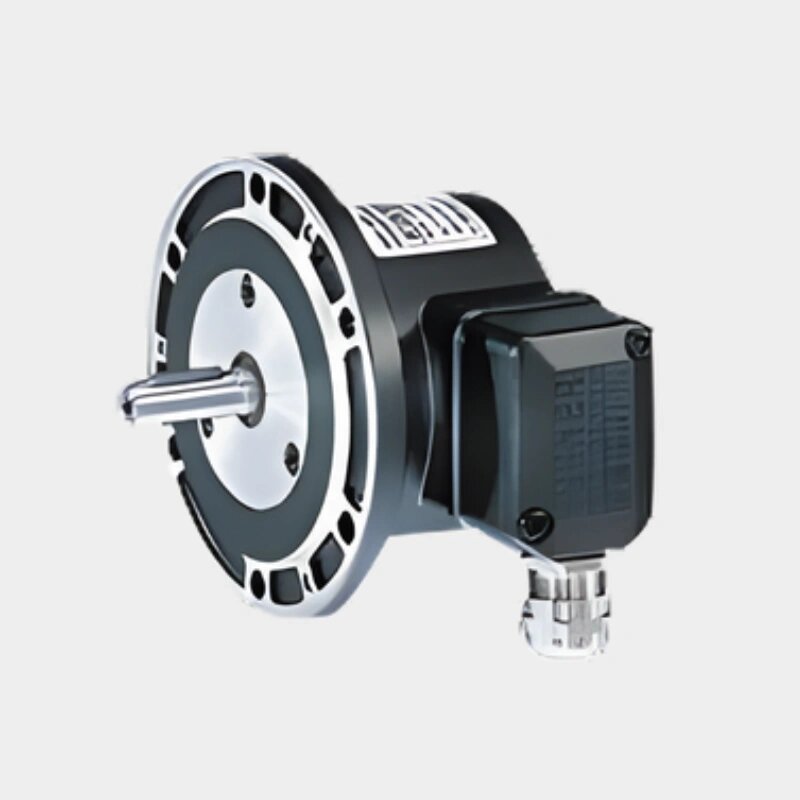
Incremental HeavyDuty encoders from Baumer Hubner deliver precise speed and angular position feedback in the industrial environments that break ordinary sensors...
Read More
The EIL 580 Series Standard Duty Incremental Encoder is a compact optical rotary encoder built for general industrial speed and position feedback where reliable...
Read More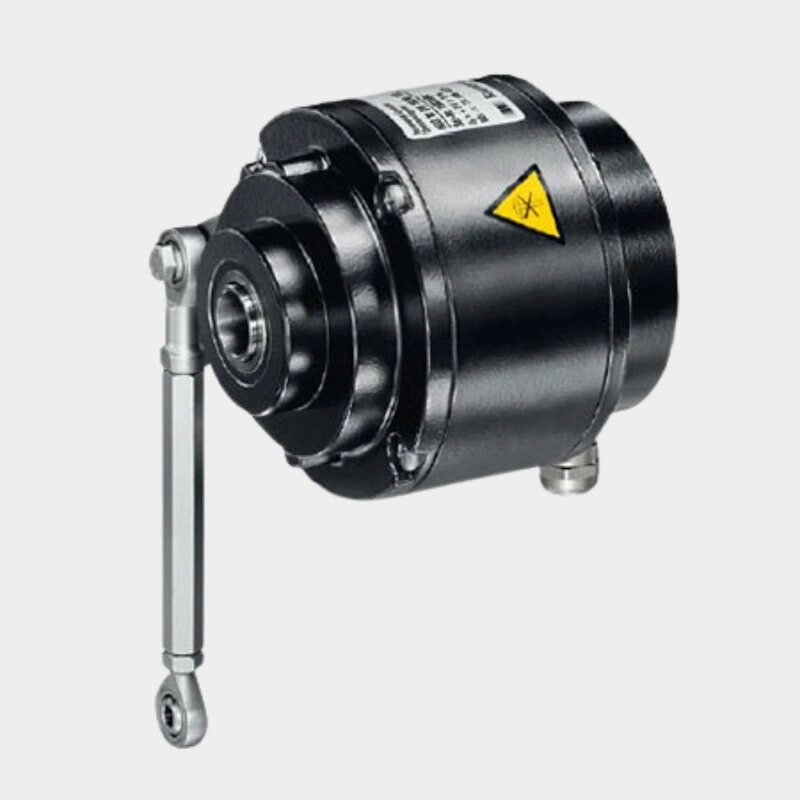
Heavy-duty rotary encoders are hollow-shaft incremental encoders built for monitoring speed and position in drive technology and motion control applications. Ba...
Read More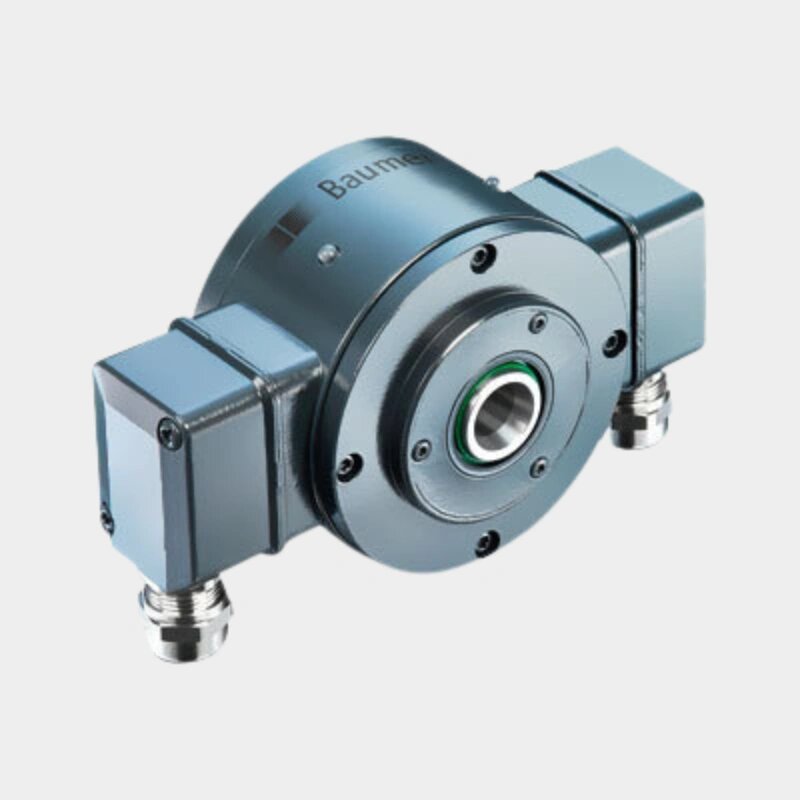
This heavy-duty rotary incremental encoder from Baumer Hubner is built for direct mounting onto a motor shaft, with no coupling required, using a blind hollow s...
Read More
The HOG 86 E is Baumer Hubner's economy-tier entry into the Heavy Duty hollow-shaft encoder range, built to carry over the core mechanical durability of the Hea...
Read More
We supply the full Baumer Hubner encoder range, from cost-effective Standard Duty models to full Heavy Duty and Economy Heavy Duty hollow-shaft encoders built f...
Read More
We trade and supply Baumer Hubner optical rotary encoders precision-built for industrial sectors that need both high resolution and serious mechanical resilienc...
Read More
Our team typically responds within a few business hours.
Fill in your details, we'll get back to you shortly.
Fill your details below to start chatting.
Fill your details below, then call us.