SMPS vs Traditional Power Supply: Which One Is Better for Modern Industries?
Modern industries rely on stable, efficient, and safe power supply systems to keep production lines, automation, and critical infrastructure running. Choosing the right power supply affects energy costs, equipment lifetime, and system reliability. Two major options dominate industrial applications, the Switch Mode Power Supply (SMPS) and the traditional power supply (usually linear power supplies or older transformer-based systems). This article compares SMPS and traditional power supply technologies, examines their advantages and limitations, and helps industrial buyers decide which suits their needs best. NEXGEN ELECTROMECH PRIVATE LIMITED provides industrial power supply solutions and can help you pick the right option — call us at 09874833686 or visit https://www.nexgenelectromech.in/ for expert support.
What are traditional power supplies?
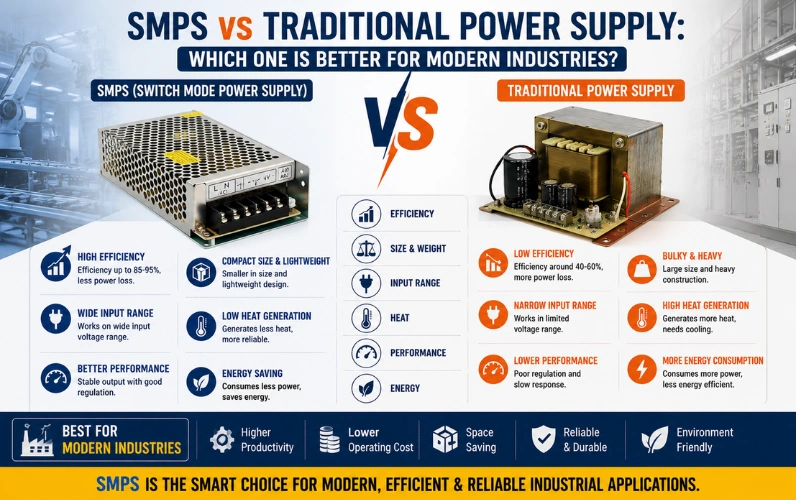
A traditional power supply typically refers to linear power supplies and older transformer-based units. These designs use heavy transformers to step down mains voltage, rectify the AC into DC, and filter it with large capacitors. Traditional power supply systems often appear in legacy equipment and in industries that originally prioritized simplicity and robustness.
Key features of traditional power supplies:
- Simple design, easy to understand and repair.
- Low electromagnetic interference (EMI) due to the absence of high-frequency switching.
- Good regulation for certain loads, and smooth DC output with minimal high-frequency ripple.
- Heavier and larger because of the transformer and passive components.
- Less efficient, especially when the output voltage is significantly lower than the input.
- Higher heat dissipation and greater cooling needs.
What is an SMPS (Switch Mode Power Supply)?
An SMPS (Switch Mode Power Supply) uses high-frequency switching to convert electrical energy efficiently. It chops the input voltage with semiconductor switches (like MOSFETs or IGBTs), passes the pulses through transformers or inductors optimized for high frequencies, and filters the output into stable DC. SMPS power supply units dominate modern electronics because they are compact, efficient, and flexible.
Key features of SMPS:
- High efficiency (often 80–95%), reducing energy waste and heat.
- Smaller size and lighter weight due to high-frequency transformers.
- Fast transient response and good regulation under variable loads.
- Higher initial complexity in design and control circuits.
- Potential for greater electromagnetic interference without proper filtering.
- Wide input-voltage tolerance, useful for global or industrial environments.
-
Performance Comparison: SMPS vs Traditional Power Supply
-
Efficiency and Energy Consumption
- SMPS: The SMPS power supply achieves much higher efficiency by minimizing the voltage drop across pass elements and operating switching devices in near-on/off states. Industries with continuous operations benefit from lower energy bills and reduced cooling costs.
- Traditional power supply: Linear designs waste excess input as heat when stepping down voltage. In high-power industrial settings, this inefficiency leads to higher operational costs and more thermal management.
-
Winner: SMPS for energy efficiency and cost savings.
-
Size and Weight
- SMPS: High-frequency operation allows for much smaller transformers and inductors. The compact form factor reduces panel space and makes integration into modern systems easier.
- Traditional power supply: Large transformers and heat sinks make these units bulky and heavy, increasing enclosure size and installation complexity.
-
Winner: SMPS for compact installations.
-
Heat Dissipation and Cooling
- SMPS: Higher efficiency reduces heat generation but concentrated components may require targeted cooling or better layout to manage hot spots.
- Traditional power supply: Generate more diffuse heat due to lower efficiency, often requiring larger heat sinks and more ventilation.
-
Winner: SMPS for lower overall heat, though cooling design still matters.
-
Electromagnetic Interference (EMI)
- SMPS: Switching at high frequencies produces EMI and switching noise. Industrial installations must include EMI filters, shielding, and proper grounding to avoid interference with sensitive equipment.
- Traditional power supply: Produce little high-frequency EMI, making them more suitable where low-noise environments matter.
-
Winner: Traditional power supply for low-EMI requirements; SMPS wins if mitigation measures are in place.
-
Reliability and Lifespan
- SMPS: Modern SMPS designs incorporate protection circuits, thermal management, and robust components. However, they use more active components (switches, controllers) that can be sensitive to surges and harsh environments if not ruggedized.
- Traditional power supply: Fewer active components can mean simpler failure modes, but aging capacitors and transformers still limit lifespan. In clean environments, linear supplies can be very reliable.
-
Winner: Tie — depends on quality, environment, and design ruggedness.
-
Regulation and Transient Response
- SMPS: Provide excellent voltage regulation and fast transient response, ideal for sensitive electronics, variable-speed drives, and automation controls.
- Traditional power supply: Offer smooth DC output but slower transient response and less ability to handle rapid load changes without significant voltage variance.
-
Winner: SMPS for modern, dynamic loads.
-
Cost Considerations
- SMPS: Higher initial design complexity sometimes leads to higher upfront costs for custom units, but mass-produced SMPS modules are often cost-effective. Long-term energy savings usually offset initial costs.
- Traditional power supply: Lower initial cost for simple, low-power applications, but higher operating costs due to poor efficiency.
-
Winner: SMPS for total cost of ownership (TCO) in most industrial scenarios.
Industrial Use Cases: Where Each Type Excels
Use cases favoring SMPS:
- Automation lines with PLCs, drives, and sensors requiring stable DC.
- Data centers and telecom power systems where efficiency and space matter.
- Renewable energy inverters and battery chargers needing high-efficiency conversion.
- Variable loads and fast transient systems like PWM drives and servo controllers.
-
Use cases favoring traditional power supply:
- Legacy machinery where simplicity and minimal EMI matter.
- Low-power, low-cost applications where heat and efficiency are not critical.
- Environments with extreme electrical noise where a low-switching design suits sensitive analog circuits.
Design and Safety Considerations for Industrial Power Supply Systems
-
Protection features
- SMPS designs typically include over-voltage protection (OVP), over-current protection (OCP), short-circuit protection (SCP), thermal shutdown, and surge protection. These features protect machinery and reduce downtime.
- Traditional power supplies often rely on fuses and passive thermal management; they may lack fast electronic protections.
-
Redundancy and fault tolerance
- Industrial power supply systems should support redundancy (N+1 or 2N) for critical operations. SMPS modules often integrate into redundant configurations more easily due to compactness and built-in control.
- For long, continuous processes, choose modular SMPS solutions that allow hot-swap replacement.
-
Environmental ruggedness
- Ensure SMPS units have wide temperature ratings, conformal coating, and industrial-grade components for dusty, humid, or high-vibration settings.
- Traditional power supplies can be robust too, but heavy transformers might suffer from mechanical stresses.
-
EMI management
- When using SMPS, design for EMI suppression: line filters, shielding, careful PCB layout, and proper grounding. Follow industrial EMC standards to avoid interference with PLCs and communication networks.
-
Compliance and standards
- Check for certifications such as IEC, UL, CE, and industry-specific standards. SMPS manufacturers often provide detailed compliance documents for industrial installation.
-
Choosing Between SMPS and Traditional Power Supply: A Practical Guide
Step 1: Assess your load and application
- For sensitive electronics, variable-speed motors, automation, and equipment with dynamic loads, prefer an SMPS power supply.
- For purely analog, low-power, or legacy systems with strict EMI constraints, consider a traditional power supply.
-
Step 2: Consider physical constraints
- If panel space, weight, or mounting flexibility matter, choose SMPS for its compact footprint.
- If size is not a constraint and you prefer simpler circuitry, a traditional unit could work.
-
Step 3: Total cost of ownership (TCO)
- Calculate energy consumption, heat management costs, and replacement frequency. SMPS often wins on TCO in continuous industrial operations.
-
Step 4: Evaluate environmental and EMI conditions
- In high-EMI-risk environments or in equipment with sensitive analog circuits, enforce EMI mitigation measures for SMPS or consider a traditional supply.
- For industrial floors, choose ruggedized SMPS models rated for dust, moisture, and vibration.
-
Step 5: Plan for redundancy and serviceability
- Choose modular SMPS units if you need hot-swap capability and easy field service. Ensure spare modules and clear maintenance procedures.
-
Real-world Example (illustration)
Imagine a packaging plant running 24/7 with conveyor motors, PLC controllers, sensors, and vision systems. Replacing old transformer-based supplies with SMPS power supply units reduces energy consumption by 15–25%, slashes heat in the control cabinet, and frees up space for additional drives. The plant also installs EMI filters and proper grounding to ensure cameras and sensors remain noise-free. Over two years, reduced energy bills and fewer failures pay back the upgrade cost, demonstrating how SMPS benefits modern industries.Practical Tips for Integrating SMPS in Industrial Systems
- Choose industrial-grade SMPS with adequate MTBF and protection features.
- Add input surge protection (surge arrestors or SPD) to handle lightning and transient spikes.
- Install EMI/RFI filters and maintain separation of power and signal wiring.
- Use proper ventilation or forced-air cooling for dense control cabinets.
- Implement monitoring: consider power supply units with telemetry or status outputs for remote diagnostics.
- Keep spares of critical modules or plan for quick module replacement to minimize downtime.
-
When Traditional Power Supply Still Makes Sense
- Small-scale or bench-top equipment where cost and simplicity beat efficiency concerns.
- Very low-noise analog instrumentation where high-frequency switching could introduce measurable interference.
- Locations with rare operation or intermittent loads where energy savings from SMPS wouldn’t justify the switch.
-
How NEXGEN ELECTROMECH PRIVATE LIMITED Can Help
NEXGEN ELECTROMECH PRIVATE LIMITED specializes in industrial power supply solutions and can assess your facility’s needs, recommend SMPS or traditional power supply systems, and provide installation and after-sales service. We help clients choose between modern SMPS power supplies and traditional power industry solutions, based on load profiles, environmental demands, and lifecycle costs.
Contact us:
- NEXGEN ELECTROMECH PRIVATE LIMITED
- Phone: 09874833686
- Website: https://www.nexgenelectromech.in/
-
Conclusion
For most modern industries, the SMPS (Switch Mode Power Supply) provides clear advantages over traditional power supplies: better energy efficiency, smaller size, superior regulation, and flexible integration into modular systems. Traditional power supply designs still hold relevance in niche cases where simplicity and low EMI matter. When selecting a power supply system, evaluate load dynamics, physical constraints, environmental conditions, and total cost of ownership. If you need a tailored recommendation for your plant or equipment, NEXGEN ELECTROMECH PRIVATE LIMITED can perform an on-site assessment and design the right power solution for your needs.